
If you've heard people talk about "OTT platforms," "OTT content," or "OTT advertising" and quietly nodded along — this guide is for you. OTT is one of those industry terms that sounds more complicated than it is. Let's break it down in plain English.
What Does OTT Stand For?
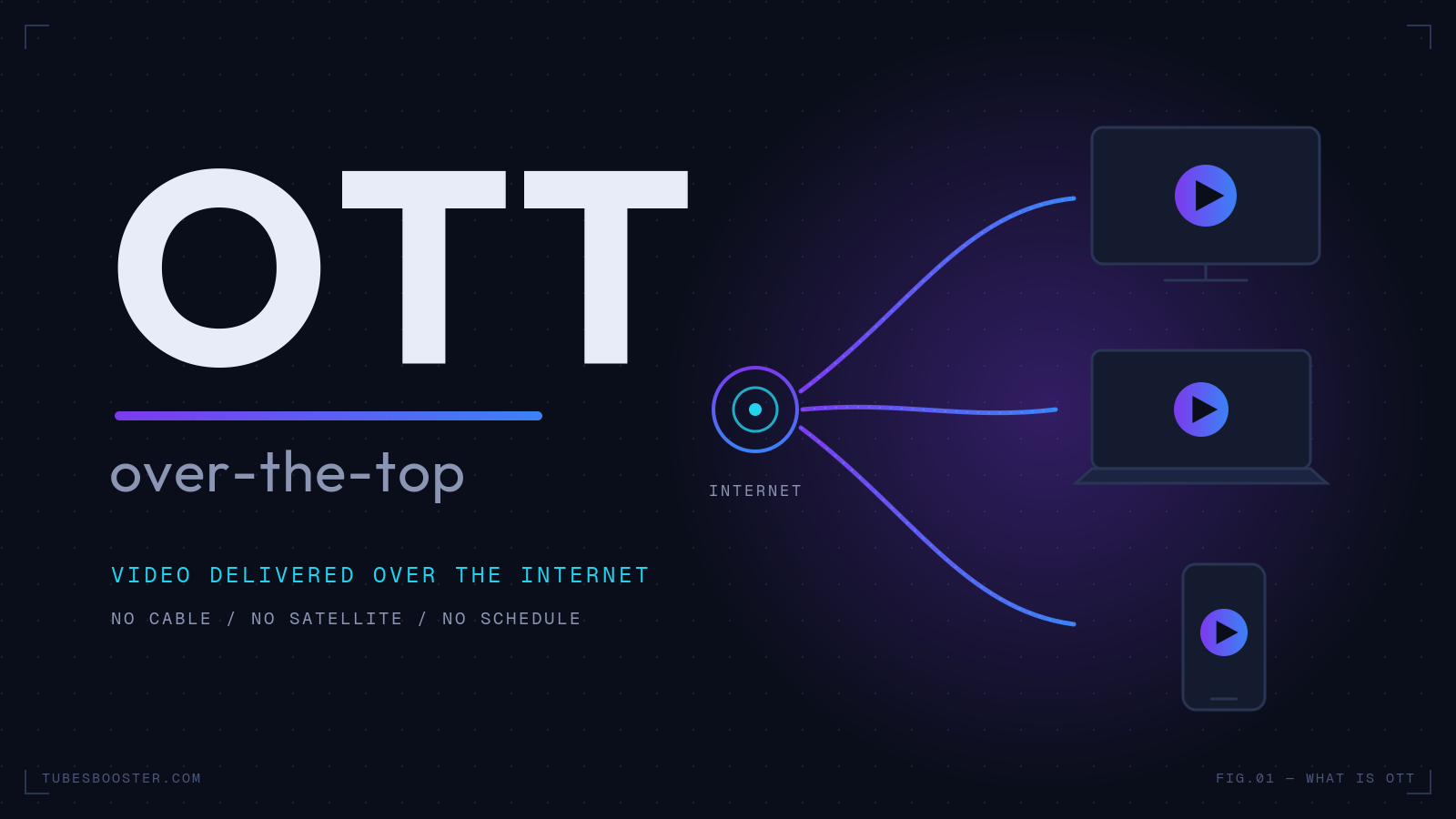
OTT stands for over-the-top. It refers to any video, audio, or media content delivered directly to viewers over the internet — going "over the top" of traditional distribution channels like cable, satellite, or broadcast TV.
In other words: when you watch Netflix on your phone, stream a video on a website, or fire up YouTube on your smart TV, you're consuming OTT content. No cable box, no satellite dish, no TV schedule. Just an internet connection.
The term originally came from the telecom industry, where services like Skype or WhatsApp went "over the top" of phone networks. Today, OTT almost always refers to streaming video delivered over the internet.
What Is OTT in Media?
In media, OTT describes the entire ecosystem of internet-delivered content that bypasses traditional gatekeepers. Before OTT, if you wanted to reach TV audiences, you needed a deal with a cable network or broadcaster. Now, anyone with content and a platform can distribute video directly to a global audience.
This shift changed the media industry in three big ways:
Direct-to-consumer distribution. Studios, creators, and independent site owners can deliver content straight to viewers, keeping control over the experience and the revenue.
On-demand consumption. Viewers watch what they want, when they want, on any device — instead of following a broadcast schedule.
Data-driven everything. Because OTT runs over the internet, every play, pause, and drop-off can be measured. That data powers recommendations, content strategy, and advertising.
What Is OTT Content?
OTT content is simply any media distributed over the internet instead of traditional broadcast. The main types are:
- Video on demand (VOD): Libraries of movies, shows, and clips viewers can watch anytime — the Netflix model, but also every video site with an on-demand library.
- Live streaming: Sports, events, webcams, and live channels delivered over the internet.
- Audio: Music streaming and podcasts also technically count as OTT, though the term is used mostly for video.
OTT content is further split by business model:
| Model | How it works | Examples |
|---|---|---|
| SVOD (subscription) | Viewers pay a recurring fee | Netflix, Disney+ |
| AVOD (ad-supported) | Free content, monetized with ads | YouTube, Tubi |
| TVOD (transactional) | Pay per video or rental | Apple TV rentals |
| Hybrid | Mix of subscriptions, ads, and pay-per-view | Most modern platforms |
If you run your own video website, you're already an OTT publisher — your site delivers on-demand video over the internet, monetized with ads, subscriptions, or both.
What Is an OTT Platform?
An OTT platform is the service or software that hosts, manages, and delivers streaming content to viewers. Well-known examples include Netflix, Hulu, Amazon Prime Video, Disney+, and YouTube.
But OTT platforms aren't limited to the giants. Any independent video site — a niche streaming service, a video membership site, a tube site — is an OTT platform. What they all have in common:
- Content management — organizing and publishing a video library
- Delivery — streaming video reliably to any device (web, mobile, smart TV)
- Monetization — ads, subscriptions, or pay-per-view
- Analytics — tracking what viewers watch and for how long
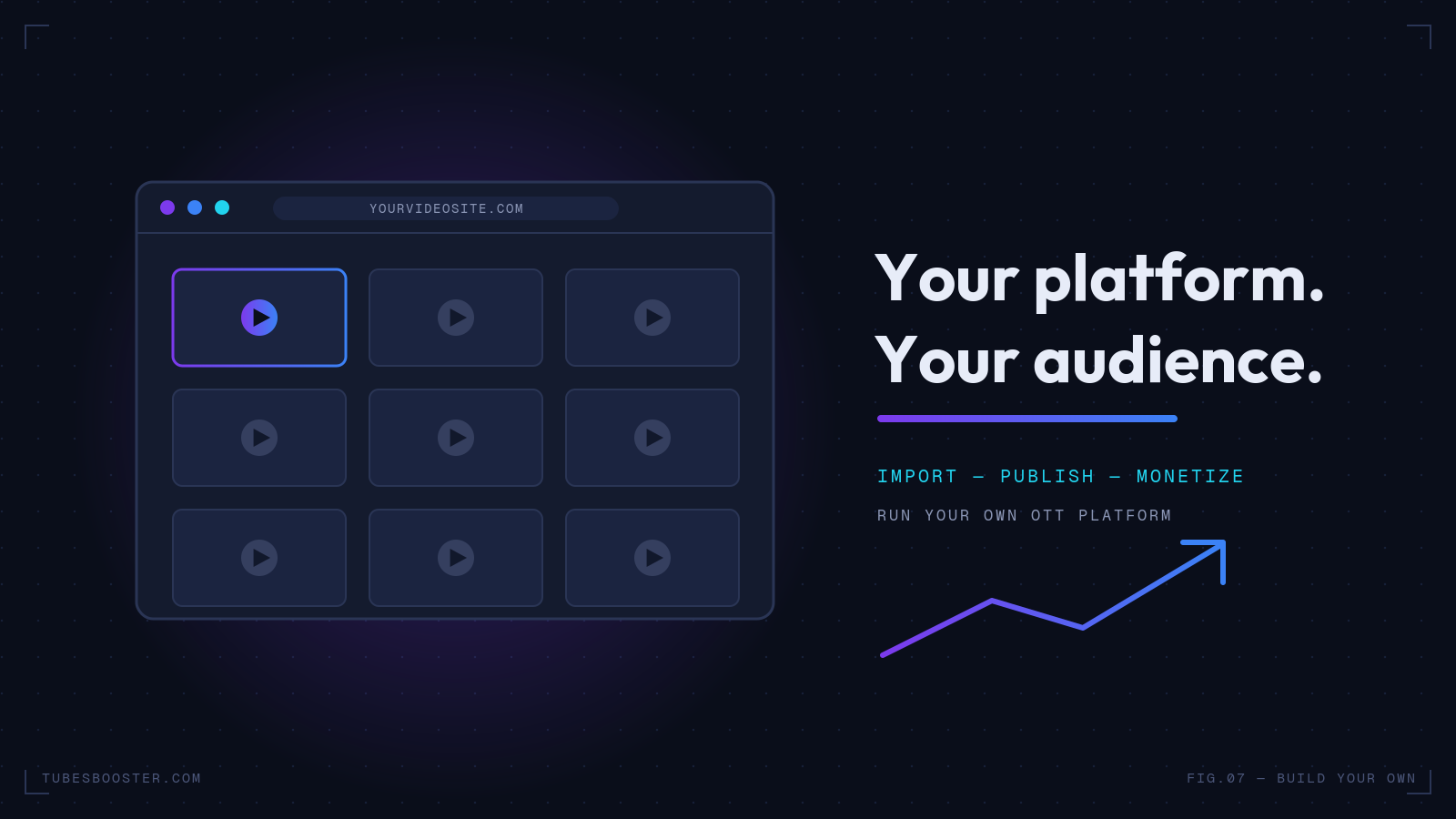
You don't need Netflix's budget to run one. Modern video CMS software handles the heavy lifting — content ingestion, transcoding, SEO-friendly publishing, and monetization — so independent operators can run professional OTT-style platforms on their own domains.
OTT vs. CTV: What's the Difference?
These two get mixed up constantly, so here's the simple version:
- OTT (over-the-top) = the method of delivery. Content streamed over the internet, on any device — phone, laptop, tablet, or TV.
- CTV (connected TV) = the device. A smart TV, or a TV connected to the internet via a streaming stick or console (Roku, Fire TV, Apple TV, PlayStation).
So CTV is a subset of OTT: all CTV viewing is OTT, but not all OTT viewing happens on a CTV. Watching Netflix on your phone is OTT but not CTV. Watching it on a Roku-connected TV is both.
This distinction matters most in advertising, where "CTV ads" specifically means ads shown on the big screen, while "OTT ads" covers streaming ads on any device.
What Is OTT Advertising?
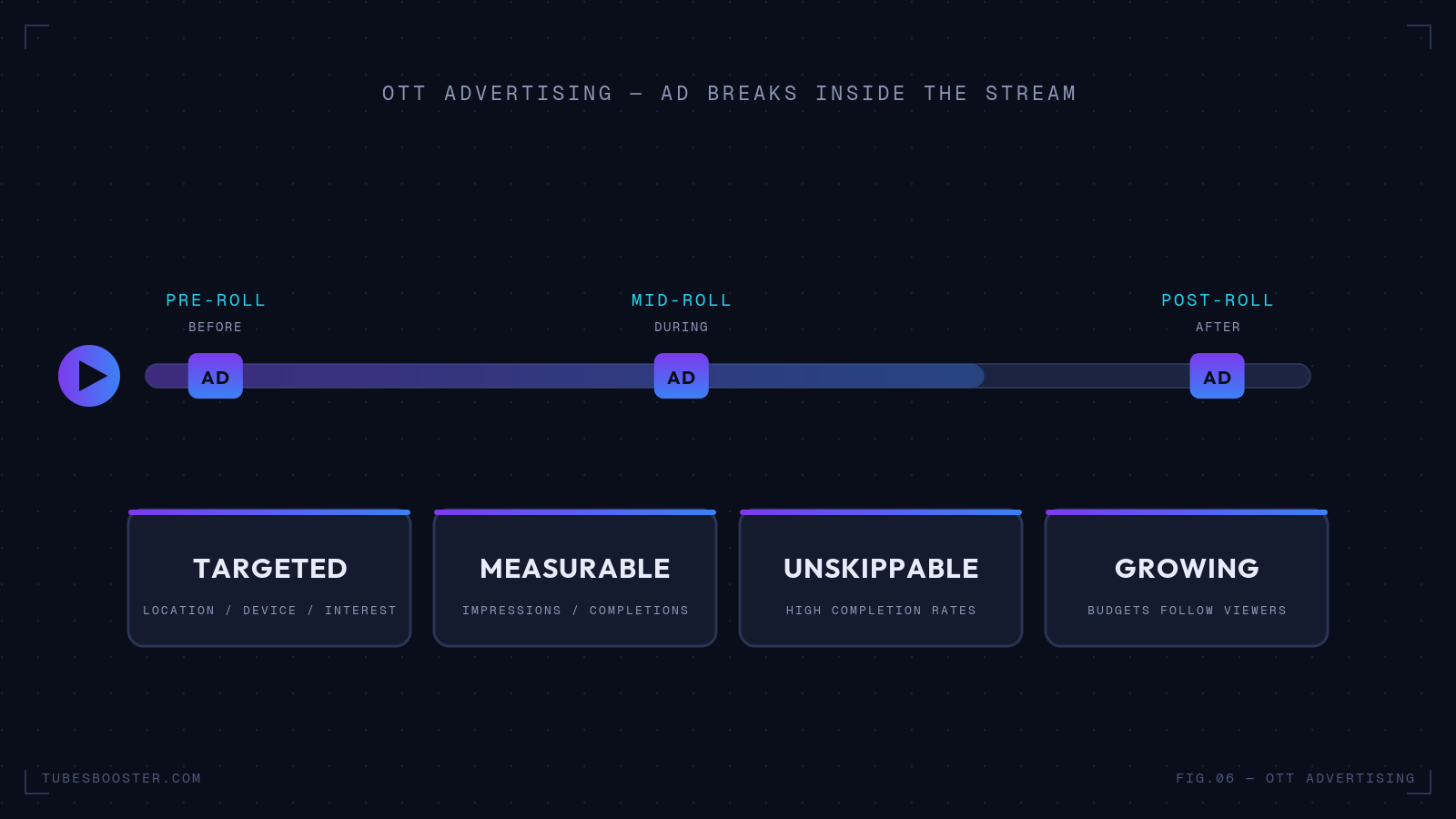
OTT advertising means delivering video ads inside streaming content instead of traditional TV commercials. Ads are served programmatically before (pre-roll), during (mid-roll), or after (post-roll) the content.
Why advertisers love it:
Precise targeting. Unlike broadcast TV, OTT ads can target by location, device, interests, and viewing behavior — closer to digital ad targeting than TV buying.
Measurable results. Impressions, completion rates, and conversions are all trackable. You know exactly how your budget performed.
Unskippable formats. Most OTT ad formats can't be skipped, so completion rates are far higher than for typical web video ads.
Reach where audiences actually are. Cord-cutting keeps accelerating — streaming has overtaken cable and broadcast viewing time, and ad budgets are following the eyeballs.
For publishers, OTT advertising is the other side of the coin: if you operate a video platform with an audience, video ad slots in your player are prime inventory you can sell directly or fill programmatically.
Why OTT Matters If You Run a Video Website
Here's the practical takeaway: OTT isn't just about the streaming giants. The same shift that let Netflix bypass cable lets independent operators bypass the old gatekeepers of video distribution.
If you run — or want to run — your own video site, you're competing in the OTT space, and the fundamentals are the same at every scale:
- Content pipeline: consistently adding fresh, organized, searchable video content
- Fast delivery: viewers abandon slow players within seconds
- SEO: for independent platforms, search is the discovery engine that recommendation algorithms are for Netflix
- Monetization mix: ads, memberships, or both
FAQ
What does OTT mean? OTT (over-the-top) means media content delivered directly over the internet, bypassing cable, satellite, and broadcast TV.
What is an example of OTT? Netflix, YouTube, Hulu, and Disney+ are all OTT services. Any independent video website that streams on-demand content is also an OTT platform.
Is YouTube an OTT platform? Yes. YouTube delivers video over the internet on demand, which makes it an OTT platform — the largest ad-supported (AVOD) one in the world.
What's the difference between OTT and streaming? They're mostly used interchangeably. "Streaming" describes the technology (playing media while it downloads); "OTT" emphasizes that delivery bypasses traditional TV distribution.
Is OTT the same as CTV? No. OTT is the delivery method (internet streaming on any device); CTV is a device category (internet-connected TVs). CTV is a subset of OTT.
Can I start my own OTT platform? Yes. With a video CMS like Tubes Booster, you can launch your own video streaming site with content management, SEO, and monetization built in — no enterprise budget required.



